Personification in poetry transforms ordinary objects into living, breathing entities that dance across the page with human characteristics.
Throughout literary history, renowned poets have mastered this powerful technique, creating famous poems that use personification to forge deeper emotional connections with readers.
These masterful works demonstrate how giving human qualities to abstract concepts, natural elements, and inanimate objects can elevate simple verses into profound artistic statements that resonate across generations.
“Because I Could Not Stop for Death” by Emily Dickinson – Death as a Gentle Suitor
“Because I could not stop for Death –
He kindly stopped for me –
The Carriage held but just Ourselves –
And Immortality.”
Dickinson’s masterpiece transforms the feared concept of death into a courteous gentleman caller, creating one of the most celebrated poems using personification in American literature. This genteel portrayal revolutionizes our perception of mortality by presenting death as patient and considerate rather than menacing.
“The Road Not Taken” by Robert Frost – Paths That Sigh and Beckon
“Two roads diverged in a yellow wood,
And sorry I could not travel both
And be one traveler, long I stood
And looked down one as far as I could”
Frost’s iconic verse breathes life into forest pathways, making them active participants in life’s most crucial decisions. The roads become living entities that beckon travelers, embodying the weight of choices that define human existence.
“Fog” by Carl Sandburg – Mist Moving on Little Cat Feet

“The fog comes
on little cat feet.
It sits looking
over harbor and city”
Sandburg’s brief but powerful poem transforms atmospheric fog into a feline creature, demonstrating how personification in famous poems can create vivid imagery through unexpected comparisons. The fog becomes a stealthy observer, silent and graceful in its urban surveillance.
“Old Man River” by Oscar Hammerstein II – The Mississippi’s Ancient Wisdom
“Ol’ man river,
Dat ol’ man river
He mus’ know sumpin’
But don’t say nuthin'”
This beloved song transforms the mighty Mississippi into an ancient sage, embodying decades of American history and human struggle. The river becomes a wise patriarch who has witnessed countless generations, making it one of the most recognizable famous poems with personification in popular culture.
More Post: 15 Famous Poems that Use Metaphors
“The Sun Rising” by John Donne – Dawn as an Intrusive Busybody
“Busy old fool, unruly sun,
Why dost thou thus,
Through windows, and through curtains call on us?
Must to thy motions lovers’ seasons run?”
Donne’s metaphysical poetry transforms sunrise into a meddlesome intruder, creating humor while exploring themes of love and time. The sun becomes an unwelcome visitor disrupting intimate moments, showcasing how personification enhances poetic meaning through unexpected characterization.
“Daffodils” by William Wordsworth – Flowers Dancing in Golden Crowds
“I wandered lonely as a cloud
That floats on high o’er vales and hills,
When all at once I saw a crowd,
A host, of golden daffodils”
Wordsworth’s nature poetry brings spring flowers to life as joyful dancers, creating one of literature’s most beloved examples of personification in poetry. The daffodils become a celebrating community, transforming a simple garden scene into a festival of natural beauty.
“The Tyger” by William Blake – Night as a Cosmic Blacksmith
“Tyger Tyger, burning bright,
In the forests of the night;
What immortal hand or eye,
Could frame thy fearful symmetry?”
Blake’s mystical verse transforms darkness into a divine craftsman, exploring creation’s mysteries through powerful personification. The night becomes an active force housing magnificent creatures, demonstrating how famous poets use personification to contemplate existence’s profound questions.
“She Walks in Beauty” by Lord Byron – Night Clothing Beauty in Starlight
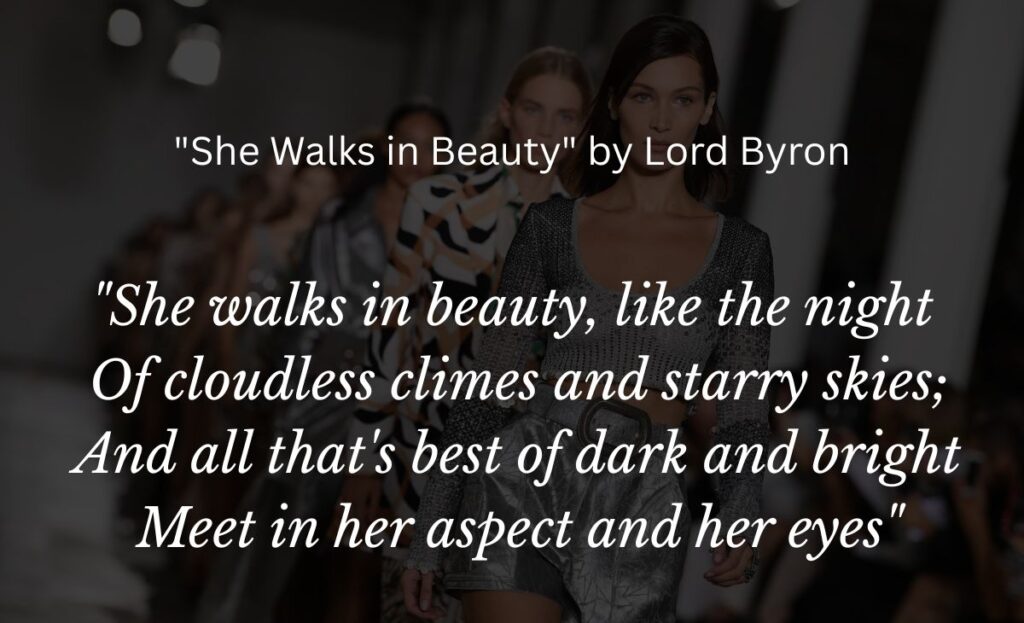
“She walks in beauty, like the night
Of cloudless climes and starry skies;
And all that’s best of dark and bright
Meet in her aspect and her eyes”
Byron’s romantic masterpiece transforms night into a fashion designer, draping feminine beauty in celestial garments. This elegant personification creates one of poetry’s most enchanting tributes to grace and loveliness.
“Stopping by Woods on a Snowy Evening” by Robert Frost – Woods with Mysterious Intentions
“My little horse must think it queer
To stop without a farmhouse near
Between the woods and frozen lake
The darkest evening of the year”
Frost imbues the winter forest with contemplative consciousness, making the woods active participants in the speaker’s internal struggle. The snowy landscape becomes a living entity that draws travelers into moments of profound reflection.
“Annabel Lee” by Edgar Allan Poe – Wind and Sea as Jealous Conspirators
“And so, all the night-tide, I lie down by the side
Of my darling—my darling—my life and my bride,
In her sepulchre there by the sea—
In her tomb by the sounding sea”
Poe’s haunting ballad transforms natural elements into envious antagonists, creating atmospheric tension through personification. The wind and sea become active agents of tragedy, demonstrating how personification strengthens emotional impact in narrative poetry.
“Sonnet 18” by William Shakespeare – Summer’s Day as Imperfect Beauty
“Shall I compare thee to a summer’s day?
Thou art more lovely and more temperate:
Rough winds do shake the darling buds of May,
And summer’s lease hath all too short a date”
Shakespeare’s immortal sonnet gives summer human flaws and limitations, contrasting temporary seasonal beauty with eternal love. This masterful personification establishes why the beloved surpasses nature’s temporary splendor.
Other Post: 35 Heartfelt Love Poems for Him That Will Make Your Boyfriend Cry with Joy
“Dreams” by Langston Hughes – Life as a Broken-Winged Bird
“Hold fast to dreams
For if dreams die
Life is a broken-winged bird
That cannot fly”
Hughes transforms both dreams and life into vulnerable creatures, creating powerful imagery about hope’s necessity. This personification demonstrates how famous African American poems use personification to convey social and personal struggles through natural metaphors.
“The Lake Isle of Innisfree” by W.B. Yeats – Peace Dropping Like Morning Dew
“I will arise and go now, and go to Innisfree,
And a small cabin build there, of clay and wattles made;
Nine bean-rows will I have there, a hive for the honey-bee,
And live alone in the bee-loud glade”
Yeats transforms abstract peace into a tangible substance that can descend like natural precipitation, creating one of poetry’s most serene examples of personification. Peace becomes a gentle visitor bringing comfort to weary souls.
“A Red, Red Rose” by Robert Burns – Love as Time’s Eternal Traveler
“O my Luve is like a red, red rose
That’s newly sprung in June;
O my Luve is like the melody
That’s sweetly played in tune”
Burns gives love enduring mobility, allowing it to survive temporal challenges through personification. Love becomes an active force capable of transcending time’s limitations, creating one of Scotland’s most cherished romantic verses.
“Ozymandias” by Percy Bysshe Shelley – Desert Sands as Silent Historians
“I met a traveller from an antique land,
Who said—”Two vast and trunkless legs of stone
Stand in the desert… Near them, on the sand,
Half sunk a shattered visage lies”
Shelley transforms desert landscape into patient chroniclers of human hubris, demonstrating how personification conveys historical themes. The sands become witnesses to empire’s inevitable decay, silently recording humanity’s temporary achievements.
“Ode to the West Wind” by Percy Bysshe Shelley – Autumn Wind as Revolutionary Spirit
“O wild West Wind, thou breath of Autumn’s being,
Thou, from whose unseen presence the leaves dead
Are driven, like ghosts from an enchanter fleeing,
Yellow, and black, and pale, and hectic red”
Shelley’s dynamic ode transforms wind into a political revolutionary, capable of destroying old orders while nurturing new growth. This powerful personification connects natural cycles with social transformation themes.
“The Bells” by Edgar Allan Poe – Bells Speaking in Metallic Voices

“Hear the sledges with the bells—
Silver bells!
What a world of merriment their melody foretells!
How they tinkle, tinkle, tinkle,”
Poe’s rhythmic masterpiece gives bells distinct vocal personalities, each type singing different life stages and emotions. The bells become a metallic chorus narrating human experience from joy through sorrow, creating one of literature’s most memorable auditory personifications.
More Post: 19 Inspiring Black History Poems for Church Services and Celebrations
“Casey at the Bat” by Ernest Thayer – Baseball Stadium Pulsing with Life
“The outlook wasn’t brilliant for the Mudville nine that day;
The score stood four to two, with but one inning more to play,
And then when Cooney died at first, and Barrows did the same,
A pall-like silence fell upon the patrons of the game”
Thayer transforms the baseball stadium into a living organism with collective breath and heartbeat, making the venue an active participant in America’s pastime. The ballpark becomes a character experiencing hope, tension, and ultimate disappointment alongside its human occupants.
“Paul Revere’s Ride” by Henry Wadsworth Longfellow – Night Galloping Through History
“Listen, my children, and you shall hear
Of the midnight ride of Paul Revere,
On the eighteenth of April, in Seventy-Five:
Hardly a man is now alive”
Longfellow gives midnight heroic agency, making darkness itself a participant in American revolutionary history. The night becomes an active collaborator in freedom’s cause, demonstrating how historical poems use personification to dramatize pivotal moments.
“The Highwayman” by Alfred Noyes – Moon as Ghostly Galleon
“The wind was a torrent of darkness among the gusty trees,
The moon was a ghostly galleon tossed upon cloudy seas,
The road was a ribbon of moonlight over the purple moor,
And the highwayman came riding—”
Noyes transforms celestial bodies into nautical vessels, creating atmospheric drama through maritime personification. The moon becomes a spectral ship navigating cloudy oceans, establishing the poem’s otherworldly romantic tension.
“Trees” by Joyce Kilmer – Oak and Maple as Worshipping Congregants
“I think that I shall never see
A poem lovely as a tree.
A tree whose hungry mouth is prest
Against the earth’s sweet flowing breast”
Kilmer’s beloved verse transforms trees into devout worshippers, giving forest giants human spiritual needs and expressions. The trees become a congregation celebrating natural beauty, creating one of America’s most quoted nature poems with personification.
“Invictus” by William Ernest Henley – Night as Unconquerable Adversary
“Out of the night that covers me,
Black as the pit from pole to pole,
I thank whatever gods may be
For my unconquerable soul”
Henley personifies darkness as a formidable opponent, transforming night into an active force testing human resilience. This powerful personification elevates the poem’s themes of courage and self-determination through cosmic struggle.
“The Love Song of J. Alfred Prufrock” by T.S. Eliot – Evening Spread Against the Sky
“Let us go then, you and I,
When the evening is spread out against the sky
Like a patient etherized upon a table;
Let us go, through certain half-deserted streets”
Eliot’s modernist masterpiece transforms twilight into a sedated patient, creating unsettling imagery through medical personification. The evening becomes a vulnerable figure awaiting examination, reflecting the poem’s themes of anxiety and paralysis.
“Chicago” by Carl Sandburg – City as Muscular Giant
“Hog Butcher for the World,
Tool Maker, Stacker of Wheat,
Player with Railroads and the Nation’s Freight Handler;
Stormy, husky, brawling,”
Sandburg transforms Chicago into a powerful laborer, giving the industrial city human strength and personality. This robust personification celebrates urban energy while acknowledging city life’s harsh realities, making Chicago itself the poem’s protagonist.
“Birches” by Robert Frost – Trees Bending Like Playful Children
“When I see birches bend to left and right
Across the lines of straighter darker trees,
I like to think some boy’s been swinging them.
But swinging doesn’t bend them down to stay”
Frost gives birch trees childlike flexibility, transforming them into nature’s playground equipment shaped by youthful imagination. The trees become willing participants in human recreation, bridging natural beauty with nostalgic memory.
“When Lilacs Last in the Dooryard Bloom’d” by Walt Whitman – Spring as Mourning Witness
“When lilacs last in the dooryard bloom’d,
And the great star early droop’d in the western sky in the night,
I mourn’d, and yet shall mourn with ever-returning spring.
Ever-returning spring, trinity sure to me you bring”
Whitman transforms springtime into a compassionate mourner, making seasonal renewal participate in national grief following Lincoln’s assassination. Spring becomes an eternal witness to both sorrow and hope, demonstrating personification’s power in elegiac poetry.
“The Wild Swans at Coole” by W.B. Yeats – Autumn Waters Mirroring Time’s Passage
“The trees are in their autumn beauty,
The woodland paths are dry,
Under the October twilight the water
Mirrors a still sky”
Yeats gives autumn lake waters reflective consciousness, making them active participants in meditation on aging and change. The water becomes a contemplative mirror, engaging with both sky and observer in moments of profound introspection.
“Mending Wall” by Robert Frost – Spring as Mischievous Wall-Destroyer
“Something there is that doesn’t love a wall,
That sends the frozen-ground-swell under it,
And spills the upper boulders in the sun;
And makes gaps even two can pass abreast”
Frost transforms spring thaw into a playful saboteur, giving seasonal change rebellious personality that challenges human boundaries. The season becomes an active agent questioning social barriers, demonstrating how personification explores philosophical themes through natural imagery.
“Do Not Go Gentle Into That Good Night” by Dylan Thomas – Night as Final Destination
“Do not go gentle into that good night,
Old age should burn and rave at close of day;
Rage, rage against the dying of the light.
Though wise men at their end know dark is right”
Thomas transforms death’s approach into a seductive destination, making mortality an active force beckoning the elderly. The “good night” becomes a deceptively peaceful invitation, creating tension between acceptance and resistance in one of poetry’s most powerful personifications of death.
“The Waste Land” by T.S. Eliot – April as Cruelest Month
“April is the cruellest month, breeding
Lilacs out of the dead land, mixing
Memory and desire, stirring
Dull roots with spring rain”
Eliot’s modernist epic transforms spring’s beginning into a heartless tormentor, subverting traditional seasonal celebrations through dark personification. April becomes an active agent of psychological disturbance, forcing life from reluctant earth and unwilling souls.
“America the Beautiful” by Katharine Lee Bates – Mountains Majestically Crowning the Landscape
“O beautiful for spacious skies,
For amber waves of grain
For purple mountain majesties
Above the fruited plain!”
Bates transforms American mountains into regal monarchs, giving geographical features royal dignity and commanding presence. The peaks become crowned rulers surveying their domain, creating one of the nation’s most beloved patriotic poems using personification to celebrate natural splendor.
Conclusion
These 35 famous poems that use personification demonstrate poetry’s remarkable ability to transform the ordinary into the extraordinary through human characteristics. From Dickinson’s courteous Death to Sandburg’s feline fog, these masterworks prove that personification remains literature’s most powerful tool for creating emotional resonance and memorable imagery. Contemporary poets continue drawing inspiration from these classics, ensuring that personification’s magic will enchant readers for generations to come.

I’m Chloe Eden, the heart behind ReverbLove.com. I Share Soulful Poems that touch Emotions, Inspire Hearts, and Celebrate Love. Words are My Art, and Poetry is My Passion.